
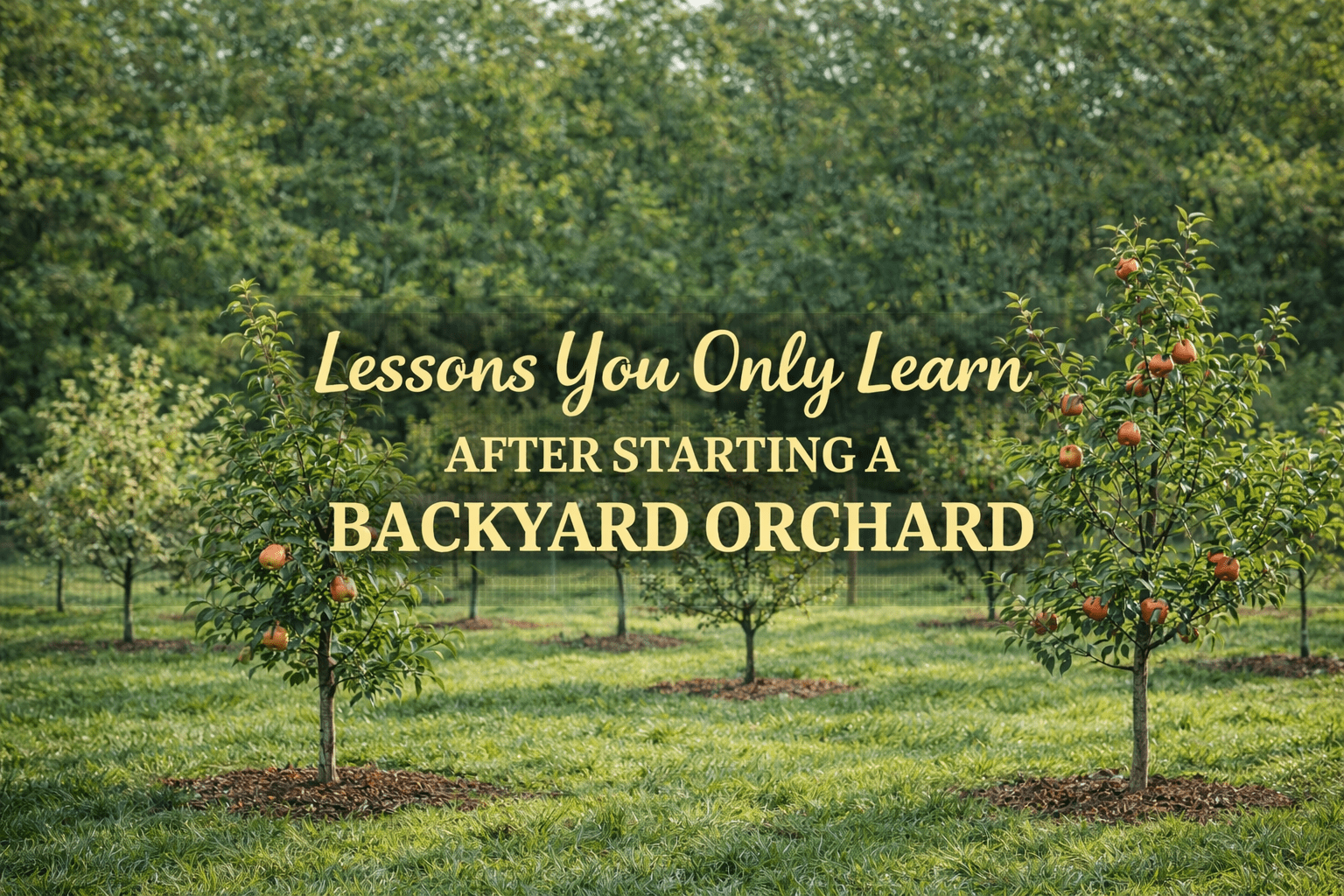
Starting a backyard orchard feels hopeful. You picture baskets of fruit, dappled shade, and trees that quietly grow alongside your life. And while all of that can absolutely happen, there are lessons you don’t really learn until you’re standing in the middle of it — hose in hand — realizing things are a little more complicated than you expected.
These aren’t mistakes so much as realities. Things that make sense only after you’ve lived with fruit trees for a while.
1. It’s Easy to Plant Too Much, Too Fast
Excitement is a powerful thing. Once you start learning about fruit trees, suddenly everything feels possible and you want to plant all of it.
What’s easy to underestimate is how much ongoing care each tree requires, especially in the early years. Watering, mulching, pruning, monitoring — it adds up quickly. Planting slowly allows you to learn your land, your climate, and your own capacity before expanding. An orchard grown in stages often ends up healthier and far more enjoyable.
2. “Temporary” Decisions Tend to Stick Around
Many orchard choices are made with the idea that they’ll be adjusted later. A tree gets planted in a less-than-ideal spot because it’s convenient, or because it’s “just for now.”
Fruit trees have a way of settling in quickly. Roots establish, branches grow, and suddenly that temporary location becomes permanent. Moving a tree later is possible, but it’s rarely simple and often stressful for the tree. Taking extra time to choose the right spot upfront saves a lot of second-guessing later.
3. Fruit Trees Take Time — and That’s Not a Flaw
It’s easy to expect fruit sooner than reality allows. Many fruit trees need several years before they produce reliably, and those early years are focused on growth and structure, not harvest.
This waiting period is important. Strong roots, good branch structure, and healthy growth set the stage for future production. Learning to value these early years for what they are — an investment — helps keep expectations realistic and frustration low.
4. Every Tree Has Its Own Personality
Even trees planted at the same time, in the same yard, can behave very differently. Some grow aggressively, others slowly. Some need frequent attention, while others quietly do their thing with very little input.
Treating all fruit trees the same often leads to confusion. Paying attention to how each one responds to pruning, watering, and seasonal changes builds experience that no guidebook can replace.
5. The Orchard Needs to Work for You, Too
Orchards aren’t just about trees — they’re about the people tending them.
Paths, access, shade, and visibility matter more than you think. If reaching a tree is inconvenient or uncomfortable, it’s more likely to be neglected over time. Designing an orchard that feels easy to move through makes regular care feel natural instead of like a chore.
6. Orchards Change as They Grow
An orchard is never finished. Trees get bigger, shade patterns shift, airflow changes, and pest pressure evolves. What works in year two may need adjusting in year six.
Flexibility is one of the most valuable orchard skills. Being willing to adapt — rather than expecting everything to stay the same — helps trees stay healthy and keeps the process enjoyable.
Most of these lessons aren’t obvious when you’re planning your orchard. They come from time, observation, and a willingness to learn along the way. That’s part of the beauty of growing fruit trees — they teach patience, attention, and adaptability in ways few other plants do.
A backyard orchard isn’t built in a season. It grows alongside you, one year at a time.